
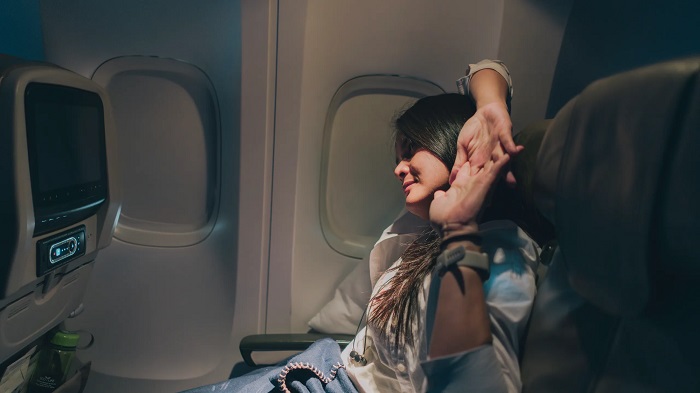

Long-haul travel can leave the hips feeling restricted, the trunk fatigued and normal training rhythms disrupted. A session on a pilates reformer can provide supported movement after extended sitting, but the first class back should not become an attempt to recover every missed workout.
The priorities are to check current capacity, reintroduce controlled movement and finish without creating excessive additional fatigue. Sleep, hydration, symptoms and travel duration should all influence the session.
Travel Affects More Than Hip Flexibility
Sitting for many hours limits positional variety, but stiffness after flying does not prove that the hip muscles have permanently shortened.
The sensation may reflect fatigue, reduced movement, poor sleep, luggage handling or temporary sensitivity. Aggressive stretching is not the only response.
Travel can also reduce coordination. A familiar exercise may feel less stable when the participant is jet-lagged or distracted.
The first session should assess these factors rather than targeting whichever area feels tightest.
Screen for Concerning Symptoms
Most post-travel stiffness is ordinary, but some symptoms require medical attention.
Unexplained chest pain, breathing difficulty or significant one-sided leg swelling and pain should be assessed urgently. Reformer exercise should not be used to test whether such symptoms improve.
A participant who feels acutely ill, faint or unable to concentrate should postpone the session.
People with relevant medical histories should seek individual travel and exercise guidance from an appropriate healthcare professional.
Begin With Supported, Familiar Movements
The first exercises should allow the participant to understand how the body responds.
Footwork can reintroduce hip, knee and ankle movement while the torso remains supported. The instructor may use a familiar spring setting and moderate range.
Simple arm movements can assess shoulder and trunk coordination after luggage carrying. Gentle strap work may explore hip movement without demanding standing balance.
The session should not begin with the most complex or unstable variation simply because the participant has previous experience.
Carriage Control Provides Useful Feedback
Travel fatigue may appear as uneven pressure or abrupt carriage speed. One leg may contribute more strongly, or the participant may struggle to control the return.
These observations should guide the session dose. They do not prove that travel caused a permanent asymmetry.
The instructor can reduce range, slow the tempo or return to two-leg work. Control should improve before complexity increases.
Repeated impact at the stopper may indicate that the participant is not yet managing the spring-assisted return.
Rebuild Hip Movement Gradually
A participant may expect deep hip extension or flexion to remove post-flight stiffness. Moving immediately to maximum range can create discomfort without improving control.
A useful progression might include:
- Supported two-leg movement.
- Moderate hip range with steady breathing.
- Staggered loading.
- Small single-leg work.
- Standing or split-stance movement if energy remains stable.
The order can change according to the individual.
The participant should leave each position with the ability to move normally, not with a strong after-effect that disrupts the rest of the day.
Trunk Control Should Include Breathing
After travel, people may brace excessively because the body feels unfamiliar. Reformer exercises can help reconnect leg and arm movement with trunk support.
The goal is not to flatten the spine or tighten the abdomen continuously. The participant should maintain enough organisation while breathing remains available.
A smaller leg range may allow better control. If the ribs lift or the lower back changes abruptly, the exercise can be modified.
Continuous maximal bracing is unlikely to support a recovery-focused session.
Account for Jet Lag
Crossing time zones can affect alertness and perceived effort. A participant may feel energetic at an unusual hour but still have incomplete recovery.
Balance, instruction processing and decision-making may be less reliable. The instructor should keep transitions clear and avoid adding complexity unnecessarily.
A morning class immediately after an overnight arrival may not suit everyone. Waiting until the following day can provide a better assessment.
The booking should reflect how the participant feels, not only when a timetable space is available.
Hydration and Meals Matter
Singapore’s heat can add fluid loss during the journey from Changi Airport or while returning to daily routines. Drinking should resume gradually rather than through a very large pre-class intake.
A heavy post-flight meal may make folded or prone positions uncomfortable. A participant should allow suitable digestion time according to individual tolerance.
The first session should not be used to compensate for disrupted eating or inactivity.
Normal meals, hydration and sleep remain central to recovery.
Rebuild the Wider Training Week
Travellers may feel pressure to resume Reformer classes, gym sessions and cardio immediately. Missed training does not need to be repaid.
A temporary return plan could include one moderate Reformer class, light normal activity and a review of recovery before higher-intensity work resumes.
Monitor:
- Energy later that day.
- Sleep that night.
- Soreness the next morning.
- Balance and concentration.
- Response during the next workout.
- Any unusual symptoms.
If recovery remains poor, additional intensity should wait.
Return According to Current Capacity
At Yoga Edition, returning travellers can tell the instructor about recent flight duration, sleep and current discomfort before beginning the Reformer session.
The machine offers support and adjustable resistance, which can make it useful for a measured return. Those features do not remove the need to manage symptoms and fatigue.
Post-travel Reformer work should restore familiarity with hip and trunk control before challenging spring settings or complex transitions return. By treating the first session as a reassessment, participants can rebuild their Singapore routine without turning temporary stiffness into an unnecessary intensity test.
